

Human Reactions and Change Management
A common reason why change initiatives fail is that insufficient attention is given to how people react. Whether it involves perceived threats to personal interests, concerns about increased workloads, or past negative experiences with change projects, it is crucial to understand and manage these reactions. By fostering a sense of involvement and highlighting individual benefits, acceptance and engagement can be increased.
A Model for Change – IFAB
To navigate the change process, CANEA’s IFAB model can be a valuable tool.
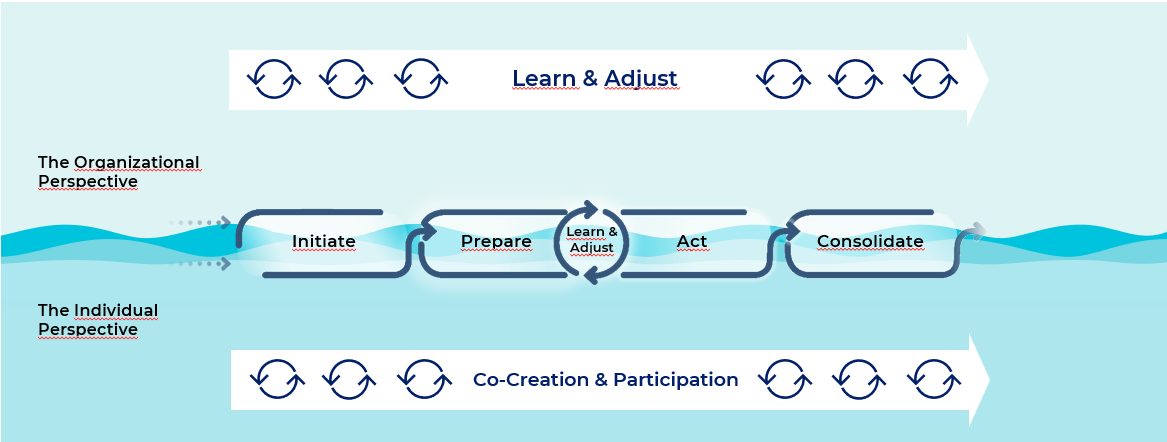 The IFAB model combines two perspectives and two approaches that together create a balanced path for sustainable change:
-
Organizational & Structural Perspective – focuses on strategic and operational aspects such as goals, resources, and processes.
-
Individual & Cultural Perspective – emphasizes the importance of including and engaging employees by fostering a sense of involvement and belonging.
Both perspectives are necessary to avoid imbalance—either being too rigid and “engineering-focused” or too vague and unstructured. Successful change requires a well-balanced combination of organizational and structural perspectives along with individual and cultural perspectives.
Approaches to Improvement and Change
The model also combines two fundamental approaches needed for successful implementation:
-
Learn and Adjust – it is important to recognize that many changes cannot be predicted in detail. An agile mindset is required, allowing learning and adjustment throughout the process in a structured way.
-
Co-Creation & Participation – to prevent “change fatigue,” the model emphasizes including and engaging employees by fostering a sense of involvement and belonging, which increases their willingness to embrace change.
While “learn and adjust” is a fundamental approach throughout the process, in most cases it is necessary to focus on tasks in a specific order. The third component therefore consists of four phases:
-
Initiate – create understanding of why the change is necessary, address reactions, and build willingness to participate.
-
Prepare – plan and remove obstacles to enable change. Communication and available resources are critical at this stage.
-
Act – carry out the planned activities, monitor progress continuously, and adjust as needed. Support individuals through coaching and feedback.
-
Consolidate – celebrate successes and integrate lessons learned into the organization. Create a structure for ongoing improvement and development.
With the right support and methodology, your organization can manage change in a way that strengthens the business while engaging employees. Contact us to learn more about how we can support your change journeys.
 Leif Nyström
Area Manager
Leif has extensive experience in strategy development, project management, and organizational and operational development. You will meet Leif in training programs focused on efficiency, project management, and management systems.