Increasing production pressure inevitably reduces margins for operational disruptions. The project therefore also focused on improving efficiency and safety while creating greater service and maintenance margins by shifting from five shifts to three.
New conform machines
The rolling mill in Helsingborg produces 130 kilotons of wire rod annually. A large share is sold to external customers, but an increasing proportion is further processed in the profile department. Production in the seven conform machines – conform stands for continuous forming and extruding – increased from 15 kilotons in 2022 to 33 kilotons in 2023 and needed to reach 40 kilotons in 2024.
It became clear early on that three new conform machines would need to be built, with commissioning scheduled for fall 2024. It was also evident that the entire organization and its ways of working needed to be reviewed in connection with the capacity increase.
Three sub-projects emerge
Initially, seven sub-projects were identified: construction of three new machines; increased equipment efficiency (Overall Equipment Effectiveness, OEE) in the profile department; supply chain quality assurance; staffing and skills alignment; infrastructure and layout improvements; financing; and system support.
However, it quickly became clear that delivering so many major initiatives within the available timeframe would be unrealistic. The scope was therefore narrowed to prioritize:
- Three new machines with associated production lines
- Higher OEE for existing machinery
- A new factory layout
The increased capacity would also allow Elcowire to move from five shifts to three. This created greater safety and maintenance margins and improved flexibility in handling additional orders. Eliminating overtime also strengthened workforce cohesion by aligning production with management’s working hours, reducing the risk of inconsistent work practices between teams.
CANEA is brought in
Elcowire initially needed support with value stream mapping (VSM), a new factory layout proposal, a framework for continuous improvement, and lean training. Dardan Berisha, management consultant at CANEA, was appointed project manager and launched a combined lean and change management program in workshop format.
A total of 70–80 employees participated. The result was greater awareness of lean principles, efficiency, waste reduction, and safety. At the same time, we laid the foundation for a stronger project structure.
When a key individual left the company at the turn of 2023/24, CANEA’s consultant assumed full responsibility as project manager for “40 in 24.”
Three new production lines
Elcowire had previously manufactured one to two conform machines per year. In 2024, production increased to seven machines, four of which were exported. The higher pace and parallel machine development significantly increased the need for structured coordination and internal alignment.
“We had not worked at this level of project orientation before. Early on, we realized that daily pulse meetings were necessary to track progress and maintain control,” says Christian Thurnäs, Technology & Maintenance Manager.
“The ‘40 in 24’ project had a challenging start, but the team – led by CANEA’s consultant – established control over the most critical areas and delivered successfully.”
A more structured project model is now in place. All projects begin with thorough feasibility studies and are then allocated the necessary time and resources.
All machines were commissioned during fall 2024 and were fully operational by year-end.
Elcowire has also partnered with JL Safety to further strengthen machine safety and is implementing full CE marking across its machinery fleet.
“We have strengthened our capabilities in project management, feasibility studies, teamwork, and resource allocation. We have also significantly deepened our expertise in workplace safety and machine safety,” Christian concludes.
The OEE project
Improving equipment efficiency focused both on optimizing the new conform machines and streamlining the entire machine fleet. This included refining how efficiency was measured and ensuring that improvement efforts became continuous rather than periodic.
“We considered conducting OEE tests on one of the new machines, but instead chose an existing machine with clear improvement potential and stable production routines,” says Mauritz Linderoth, then Process Manager and now Process Developer in the profile department.
“The advantage was that we had a reliable baseline. We selected the Conform C87 machine, which had an OEE of 63 percent after adjusting for downtime caused by packaging supply issues. We believed it could serve as a model for the rest of the fleet.”
Data-driven improvements
The work was highly experimental. Rather than relying solely on workshops, the team conducted extensive data analysis since downtime causes were well documented. Every minute of stoppage and its root cause had been logged in a database.
“We categorized the data into four main areas: operator, speed, maintenance, and planning. Through targeted workshops and operational adjustments, we increased OEE to 75 percent simply by maintaining correct operating speeds and standardizing operator procedures.”
Long-term measures were also identified, including continuous servicing and optimized machine parameter settings.
Key lessons and measurable results
In the profile department, machines are now shut down once a month for planned servicing. During these stops, additional preventive maintenance is carried out, such as lubrication checks across all machines. This initiative originated from the project and now applies to all production lines.
A standardized best-practice framework for product changeovers has also been introduced, ensuring consistent and efficient transitions between production runs.
Lean principles now guide daily operations. Work is carried out according to best practice, lessons learned are systematically applied, and problems are addressed at their root cause.
“The most important insight is that thoroughly analyzing the causes of errors and downtime allows significant improvements without major capital investments. We increased OEE from 63 percent to 83 percent on a limited budget. At the same time, we were able to run the machines at higher capacity without experiencing technical issues or speed losses.
“That is perhaps the most important lesson – how far you can go through disciplined and systematic work,” Mauritz concludes.
About Elcowire
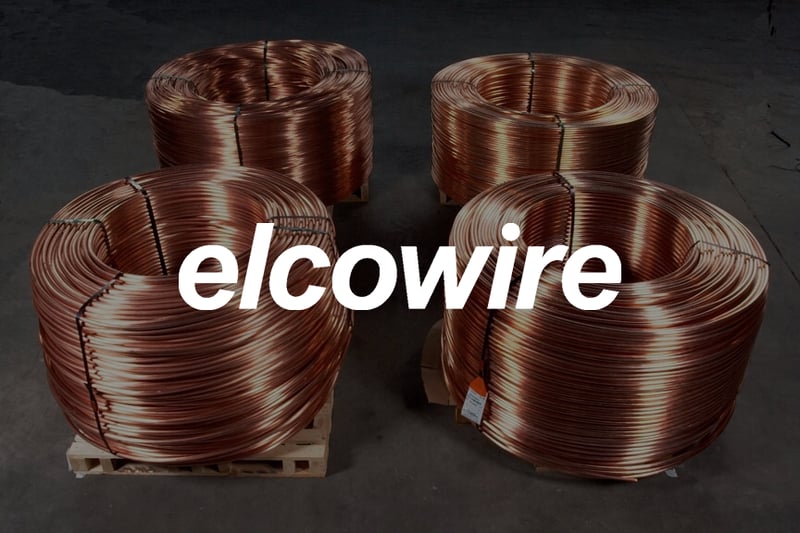
Elcowire AB is one of Europe’s leading suppliers of copper and aluminum wire-based products and services for electricity transmission. Customers operate in industries such as energy transmission, railway infrastructure, and electrical engineering. Manufacturing takes place in Sweden and Germany, and the headquarters is located in Helsingborg.
The company has 400 employees and reported annual revenue of EUR 1.4 billion in 2023.
Elcowire develops and builds its own conform lines. A conform machine measures approximately 15 meters from coil to coil. The incoming coil of round wire weighs 5 tons. The wire is heated and drawn through forming tools to achieve a new geometry with a reduced cross-sectional area.
 “CANEA’s project manager drove the initiatives forward and provided valuable external perspective.”
“The collaboration with CANEA worked extremely well. The consultant was instrumental to our success.”
Paul Gustavsson
CEO, Elcowire Group AB
.png?width=800&name=Aveki%20(testbild).png)